Kalimantan · National park stay
Tanjung Puting National Park
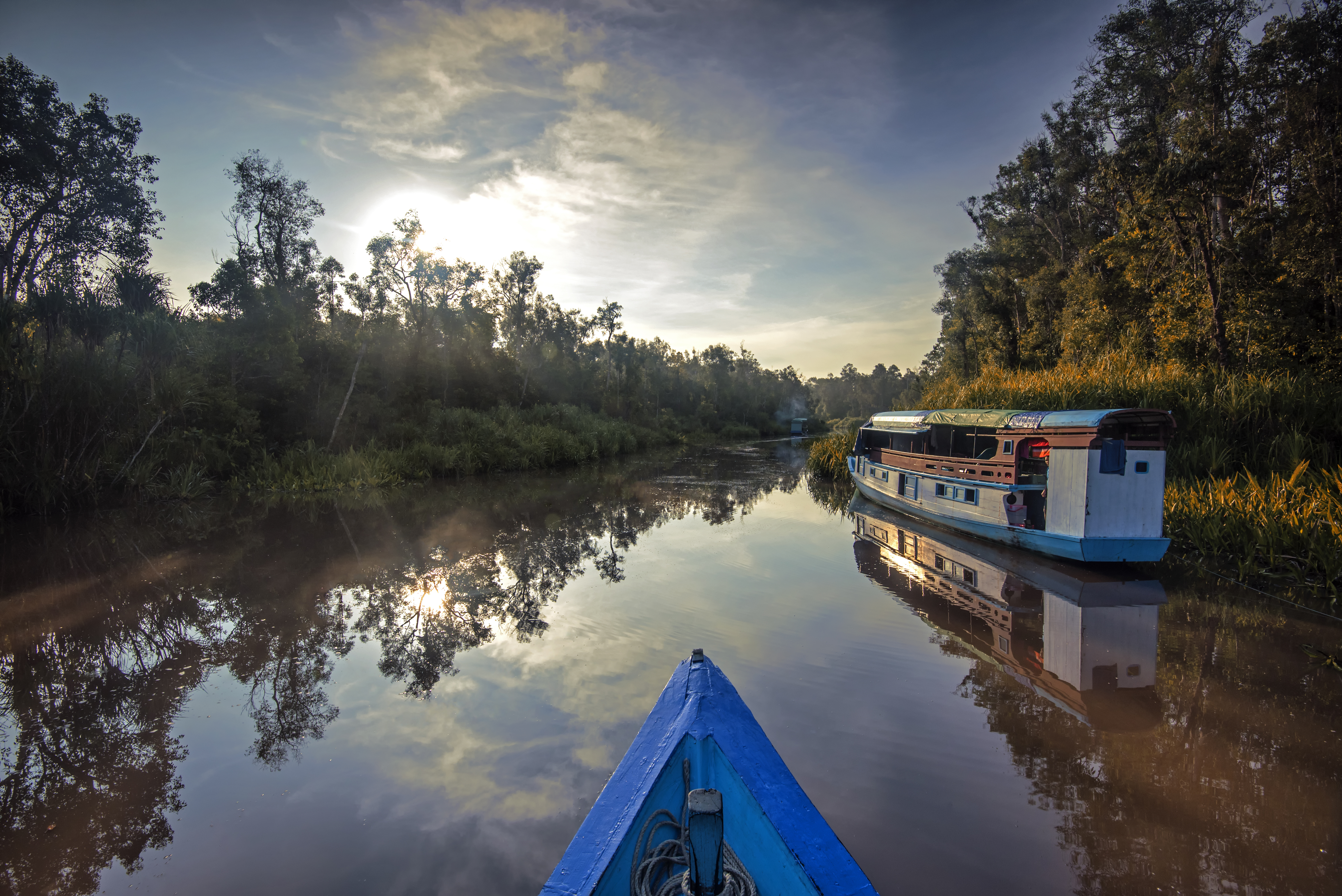
Tanjung Puting is a Central Kalimantan (Borneo) national park reached only by boat, where the standard trip is a multi-day klotok (traditional wooden houseboat) cruise up the Sekonyer River to visit orangutan feeding stations — a genuinely different, boat-based multi-night trip shape from a city day-trip attraction, not a side excursion from the Pangkalan Bun gateway town.
Overview
Overview
Tanjung Puting is a Central Kalimantan (Borneo) national park reached only by boat, where the standard trip is a multi-day klotok (traditional wooden houseboat) cruise up the Sekonyer River to visit orangutan feeding stations — a genuinely different, boat-based multi-night trip shape from a city day-trip attraction, not a side excursion from the Pangkalan Bun gateway town.
The klotok is your accommodation for the length of the trip — there is no in-park hotel choice to compare. Plan for one additional overnight in Pangkalan Bun (the airport gateway town) before or after the boat trip, since Kumai, the port town where boats depart, has limited accommodation of its own. Entry requires an official park reservation and permit through the park authority's own e-ticketing system; exact fees are set by national government regulation and have changed in recent years, so confirm current fees and reservation mechanics on the official portal before you travel. The dry season (roughly May/June–September, peaking July–August) brings steadier river conditions and more predictable wildlife visibility; the wet season (roughly October/November–April) brings higher, more variable river levels and occasional schedule disruption. A multi-day boat trip with limited connectivity and modest healthcare access along the way is a genuine fit factor worth assessing before booking, not a reason to avoid an otherwise well-established ecotourism route.
Experience
What it's like
For the standard multi-day trip, the klotok is both your transport and your accommodation — you sleep aboard for the length of the cruise, with meals prepared onboard. This is a genuinely different stay pattern from a hotel-based day trip: there is no in-park hotel choice to compare, so this page does not present a Stay comparison tab. A small number of park-edge ecolodges and homestays exist near Sekonyer village for travelers who want to break up the boat-based pattern, but the klotok is the default way to stay. Most operators and guides converge on roughly two to four nights aboard as the practical range: fewer nights means less time at the outer feeding stations and a more rushed pace; more nights allows slower river travel and better odds of wildlife sightings away from the feeding platforms. Separately, plan for one overnight-before-or-after-departure night in Pangkalan Bun — nearly every visitor stays there rather than in Kumai, given Kumai's limited accommodation.
Areas to know
These are reference descriptions of areas within Tanjung Puting National Park — not a stay comparison.
- Pangkalan Bun — The air gateway and practical overnight-before-departure base — not an independent multi-night stay destination on the evidence available. Beyond the airport transfer and a pre/post-trip hotel night, a modest set of in-town sights (see Things to do) can fill an optional half day for travelers already passing through.
- Kumai — The small port town where klotok boats depart, roughly 20–45 minutes by road from Pangkalan Bun airport. Accommodation here is limited; most travelers pass through only briefly on the way to or from the boat rather than staying overnight.
Reservations and permits
Entry requires an official park reservation through the park authority's own SITANPAN e-ticketing system (individual and tour-agency booking tracks exist separately), with a published daily reservation window; academic/researcher entry goes through a separate e-SIMAKSI permit process. Entry fees are set by national government regulation and have already changed at least once in recent years — confirm current fees and reservation mechanics on the official portal before you travel rather than relying on a fixed number here.
Booking pattern
Most travelers book a klotok trip in advance through a Pangkalan Bun-based agency, commonly two to three weeks ahead for dry-season travel when demand is higher. Booking on arrival is possible but narrows your choice of boat, crew, and group composition. Klotok charter and per-person pricing vary meaningfully by boat class, group size, and season — confirm current pricing directly with an operator rather than relying on a fixed figure here.
Fit and constraints
A multi-day klotok trip means several days with limited connectivity, boat-based mobility (narrow gangplanks, short forest walks on sometimes muddy or uneven trails), heat, humidity, and — outside the dry season — leeches. Healthcare access from deep in the park is limited, so travel insurance with medical evacuation coverage is a reasonable precaution, alongside personal medication and basic first-aid supplies. None of this makes the trip unsuitable for most travelers — it is a well-established ecotourism route with experienced crews and active park rangers — but it is worth assessing honestly against your own comfort with several boat-based days before booking.
Things to do
- Feeding stations (the core park experience) — Tanjung Harapan, Pondok Tanggui, and Camp Leakey are the three feeding stations most klotok itineraries visit in sequence, each offering a different vantage on semi-wild and wild orangutans, with proboscis monkeys, macaques, and other wildlife visible along the river between stops. Wildlife beyond the feeding stations is opportunistic, not guaranteed, and is more frequent in the dry season.
- Camp Leakey — An active Orangutan Foundation International research station founded in 1971 by Dr. Biruté Galdikas and Rod Brindamour. Day visitors may observe with a permit and a guide; overnight stays at the camp itself are not permitted for visitors, so this remains a day-visit stop within your multi-day klotok trip, not a separate lodging option.
- Pangkalan Bun in-town (optional add-on) — Istana Kuning (a reconstructed former sultanate palace) and Istana Mangkubumi (a second palace/heritage site with more personal, guided storytelling), local markets in both Pangkalan Bun and Kumai, a Dayak longhouse replica, and an Arut River canoe cruise are the main in-town sights — realistically an optional half day before or after your park trip rather than a reason to visit Pangkalan Bun on its own.
Plan your visit
Plan your visit
When to go
The dry season, roughly May/June through September and peaking in July–August, brings lower and more stable river levels, firmer trails, and more predictable feeding-station wildlife activity. The wet season, roughly October/November through April, brings heavier rain, higher and more variable river levels, occasional schedule disruption, and muddier trails — but fewer visitors and a lusher forest. Even in dry months, afternoon thunderstorms remain possible, so rain gear is worth packing year-round. Confirm current river and trail conditions with your operator close to travel rather than relying on a fixed seasonal calendar.
Getting there & around
Getting there
Tanjung Puting has no road access — the only way in is by boat. Fly into Pangkalan Bun's Iskandar Airport (PKN), the air gateway for the park trip and for Pangkalan Bun itself, served by domestic-only routes from Jakarta, Surabaya, Semarang, Ketapang, and Sampit (exact flight schedules and frequencies change and are worth confirming close to travel). From the airport, a road transfer of roughly 20–45 minutes reaches Kumai, the small port town where klotok (traditional wooden houseboat) trips depart; a short boat crossing (commonly 15–25 minutes) then takes you from the Kumai River into the Sekonyer River, the park's main access river. Kumai's own accommodation is limited, so most travelers spend one night in Pangkalan Bun — either before departure or after returning — rather than in Kumai itself.
Getting around
Once inside the park, the klotok itself is your transport for the length of the trip; short guided walks from riverside docks reach the Tanjung Harapan, Pondok Tanggui, and Camp Leakey feeding stations. There is no independent walking network beyond these dock-adjacent trails, and trails can be muddy and uneven, especially outside the dry season.
Your trip
How Tanjung Puting National Park fits your trip
May suit travelers drawn to a multi-day, boat-based wildlife trip who are comfortable with several days of limited connectivity and heat/humidity, deciding primarily on trip length (roughly two to four nights aboard) and season rather than on a choice between competing stay areas.
Dates, other stops, and what matters on this trip can make this fit clearer.
Add dates and other stopsInformation used
Information used
Reference information — Balai Taman Nasional Tanjung Puting (SITANPAN) · Ministry of Environment and Forestry (KLHK) · Directorate General of Civil Aviation (Kemenhub) · Orangutan Foundation International (OFI) — official park, government, and research-institution sources for park identity, ticketing, airport gateway, and Camp Leakey.
Wherely research — Wherely's own dedicated research for Tanjung Puting National Park, additionally triangulated across independent editorial and operator sources covering the multi-day klotok trip structure, the gateway/overnight role of Pangkalan Bun, official reservation and permit mechanics, seasonality, and fit/constraint realities. Exact fees, permit prices, klotok charter prices, and flight schedules change too often to publish as fixed facts.
Photo credit
Hero photograph: Tanjung puting hero photograph by Nala Rinaldo, licensed under CC BY-SA 4.0.
What to do next
What to do next
Return to Kalimantan when you want the wider geography, or save this Place when it still fits.